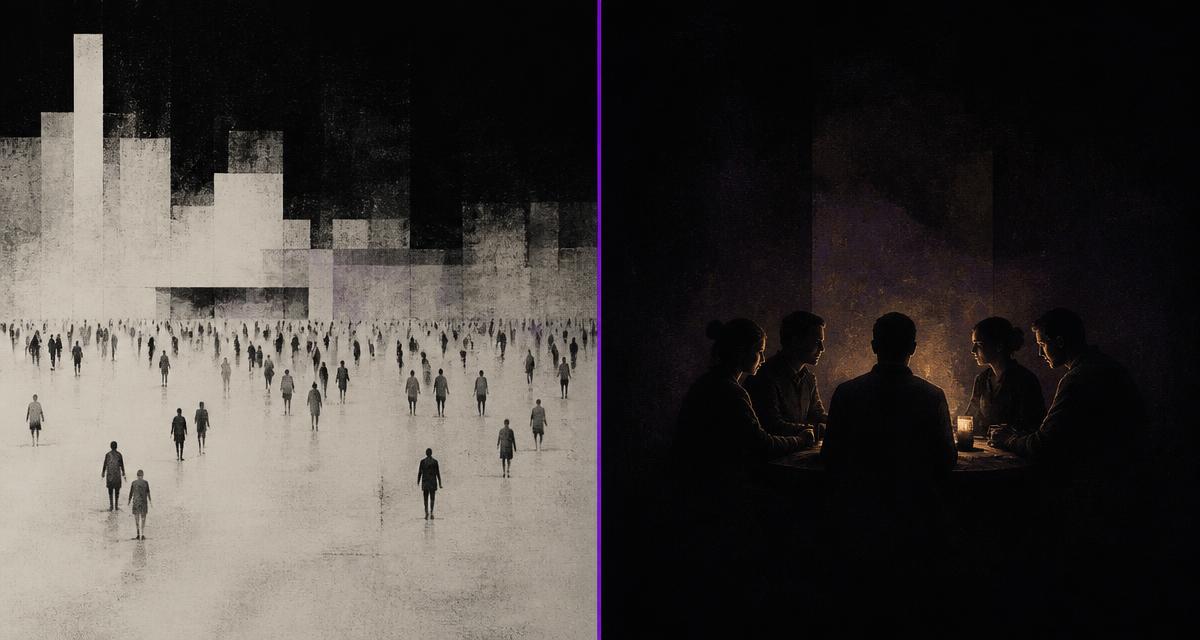
The choice people think they are being offered is all or nothing. Go private, which apparently means deleting the accounts, walking away from the followers, and disappearing from the places where your work, your hobbies, and half your acquaintances live.
Almost nobody does it, including the people who genuinely want to. The cost is too high and it is aimed at the wrong thing. Your public presence is not the problem.
The actual problem
Public platforms were not designed for private life. They were designed for distribution, and they are very good at it. Everything intimate that happens on them happens in a feature that was bolted on later: a group chat, a close-friends list, a story audience toggle buried two screens deep.
Those features are not bad. They are just afterthoughts inside a product whose central mechanic is reach. A thread inside a broadcast app inherits the broadcast app's defaults, its notifications, its noise, and its incentives. It was never going to be enough, because it was never the point.
The answer is addition, not subtraction
You do not need to delete anything. Keep the public accounts. Keep posting the work, the announcements, the things you actually want strangers to see. That surface has a job and it does it.
What is missing is a second place. Somewhere that holds the twelve people who know your kids' names, where the default audience is those twelve people and nothing you post has to survive contact with anyone else.
What the split looks like
- You post the highlight reel publicly. You share the unfiltered version, the outtakes and the bad lighting, in your orbit.
- Your professional network sees the career win. Your orbit sees the Tuesday that fell apart on the way to it.
- Your followers see the product. Your orbit sees the person.
None of those pairs are in conflict. They are two different rooms, and needing both is not hypocrisy. It is how people have always worked.
Not going dark
Orbit is not a protest against public social media and it is not a detox app. There is no counter of days since you last posted, no lecture about screen time.
It is a place where the audience is finite, named, and invited by you, so that nothing you share has to be edited for people who were never in the room. Your public life keeps doing what it does. This is the other half.
If you want the mechanics rather than the pitch, how Orbit protects you walks through them, and private social media is not antisocial makes the case for smaller audiences.