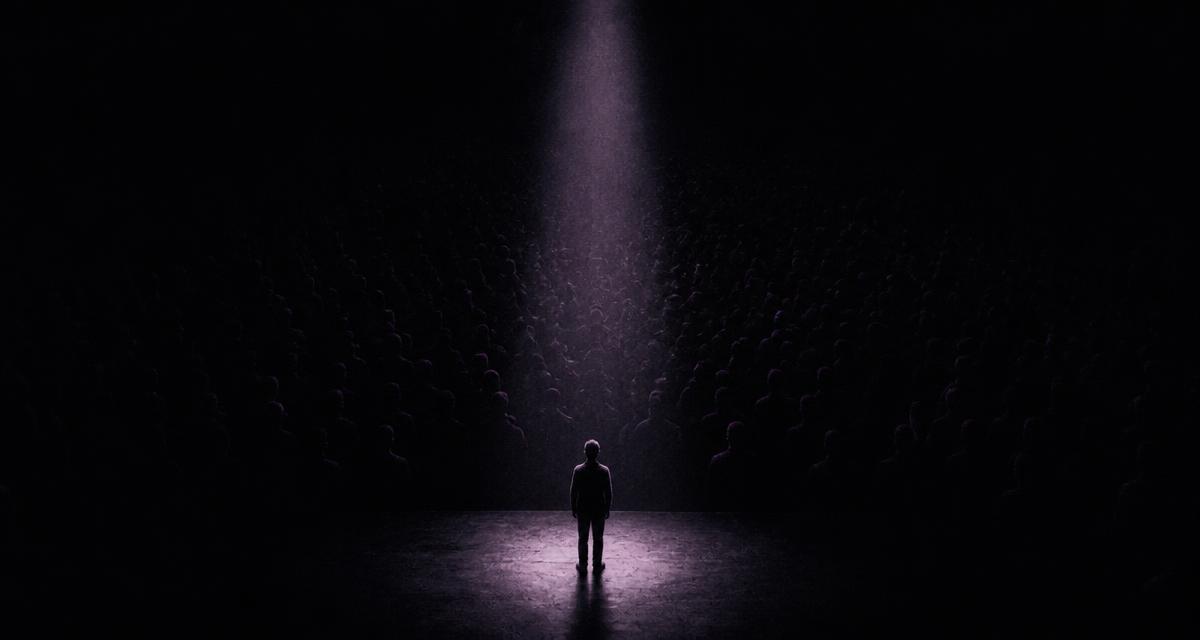
There is a round of editing almost everyone does before posting something public, usually without admitting it is happening. Is this too personal? Is it boring? Will anyone care? Does this represent me correctly to every single person who might see it?
By the end of that pass, the thing you wanted to say has been sanded into something safe. Often it does not get posted at all.
The behavior has a name
Researchers who study self-presentation online call it context collapse: a boss, an ex, a cousin, a client, and a stranger all occupying one audience, so there is no version of a message that is right for all of them. The companion concept is the imagined audience, the crowd you picture while writing, which is almost never the crowd that shows up.
The documented responses are two, and they pull in opposite directions. Some people over-share and perform, because a reaction is the only feedback the system gives. Most people under-share and hide, because flattening is safer than being misread. Neither is a personality flaw. Both are rational answers to an audience you cannot see.
What it does over years
Public feeds become highlight reels, not because everyone decided to lie, but because the highlight is the only category that survives the editing pass. Announcements, wins, finished things.
Which means the rest of a life stops being shared anywhere. The uncertainty, the small wins that need context, the ordinary Tuesday. Not hidden exactly, just homeless.
The group chat absorbs some of it for a while. Then the chat gets busy, the thread fills with logistics, and the photo you wanted people to actually see scrolls past three messages about dinner.
The cost is not only yours
This part gets missed. The self-censorship is usually framed as a personal wellbeing issue, and it is one, but the bigger loss lands on the relationships.
The people who care most about you end up receiving the same edited feed as everyone else. They know your announcements and not your life. Closeness is maintained by a steady flow of unremarkable detail, and that flow is exactly what an unclear audience shuts off.
The premise Orbit is built on
Sharing with eight people who know you is worth more than broadcasting to eight thousand who do not.
When the audience is a named, finite group you invited, there is nothing to manage. No optimizing, no imagining who might see it, no deciding whether a bad week is on-brand. The content gets more honest because the room got smaller.
There is no public feed in Orbit, no follower count, no discovery surface, and no ranking system deciding which of your people see you this week. Related reading: private social media is not antisocial and you don't have to choose between your public life and your private one.